

Philosophy Guides Your Interpretation
How To InvestWes Crill, PhD
Senior Client Solutions Director and Vice President
How you interpret events often depends on your belief set. For example, I enjoy fireworks because I believe when deployed in celebratory fashion, they’re mostly harmless. My dog abhors fireworks because she thinks they’re the end of the world.
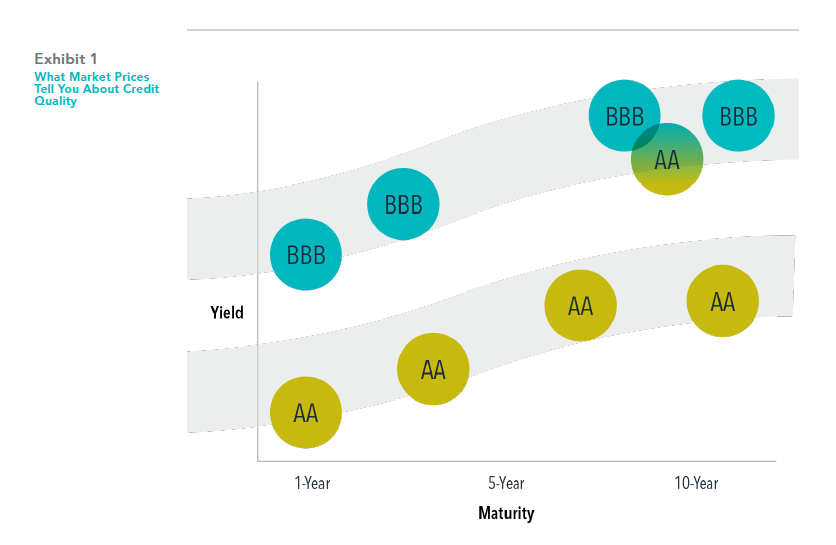
A similar dissonance may unfold when it comes to bond yields. Generally, bonds with similar stated credit ratings will trade at similar yields, with lower-rated issues (BBBs in this example) in a higher-yield tier than the higher-rated bonds (such as AAs). But sometimes you find outlier bonds, or those trading at yields closer to a different tier of credit quality. How you interpret these cases likely depends on your investment philosophy.
An active investor who believes in spotting mispriced securities may see an AA trading like a BBB as a market timing opportunity—you get the relatively lower risk of an AA but the higher expected return of a BBB. On the other hand, an investor who believes in the power of markets would infer that the outlier bond’s yield signals the market is ahead of rating agencies in determining the bond is riskier than its AA rated brethren, and the higher yield is compensation for the additional risk.
One of those interpretations is tantamount to a free lunch, which markets are not in the habit of providing. The other is a “looks like a duck, quacks like a duck” premise, which better aligns with an investment philosophy rooted in competitive equilibrium markets and suggests the need for continuous credit monitoring incorporating market-based indicators.
For illustrative purposes only.
Credit rating: Represents the creditworthiness of a bond. Ratings are published by credit rating agencies.
Expected return: An estimate of average anticipated returns informed by historical data.
Yield: The return on a bond investment. Price and yield are inversely related, and as the price of a bond goes up, its yield goes down.